
EU Directive 2023/2673 Compliance in Practice
Looking for a simple path for withdrawing from an online contract? See what a request, a dated confirmation, and a recorded case look like in day-to-day store operations.
You sell online in the European Union and you’re looking for a way to let customers withdraw from a contract through a simple path, one that leaves you a clear record. This page shows what that path looks like in day-to-day operations, it doesn’t discuss the regulation itself. It’s not legal advice either: exactly how it applies to your sales is something your lawyer should assess.
Where the problem usually lies
The trouble rarely starts with the requirement itself. It starts with how it’s carried out once requests start piling up:
- a cancellation link buried somewhere in the terms and conditions,
- withdrawal statements arriving by plain email and handled manually,
- confirmations sent differently depending on who happened to reply,
- no certainty about exactly what a request concerned and when it came in.
The last point is the most troublesome, because the date the statement was filed determines how deadlines run. An email inbox is a poor place to keep that kind of evidence, and in a dispute with a customer, it’s often the only source there is.
What this path looks like in RetJet
Your store page carries a visible entry point to the form, instead of a link hidden in a document. You can embed it as a button that opens a popup, or send the customer to a ready-made form address on our side.
From there, the same thing happens as with any other request:
- The customer indicates what the case concerns and which order.
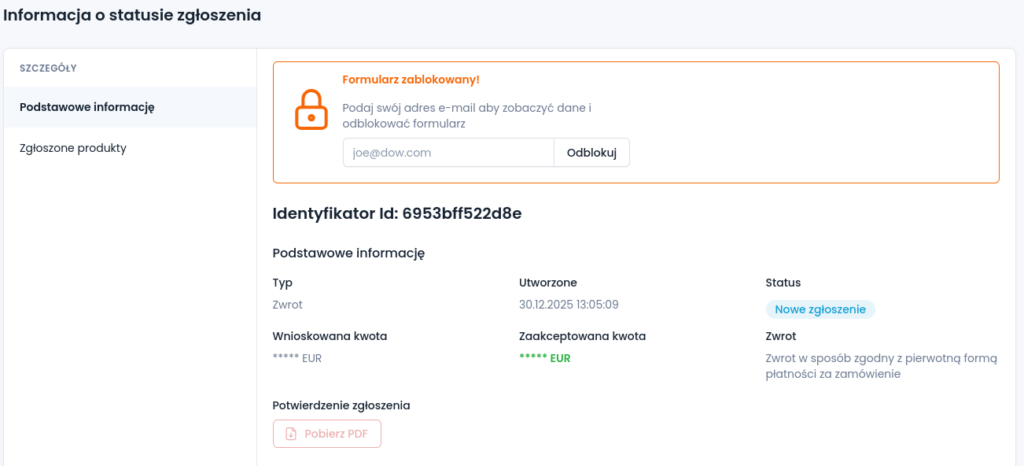
- After submitting the form, they get a confirmation and a link to view their case.
- RetJet records the date of the request, its contents, and all further correspondence.
- The case moves on through the normal path: sending the shipment, receiving the item, settlement.
The customer doesn’t need to create an account or send more messages to check where the case stands. They have their own request page with a status and the option to write to you, so questions don’t scatter across inboxes.
What this delivers in day-to-day work
One record instead of three places. The date, contents, and contact history sit with the request, not in one person’s inbox.
The same flow every time. The confirmation goes out automatically, so it doesn’t depend on who happened to be handling the request or whether they remembered to reply.
Withdrawal doesn’t close the case, it starts it. After the statement, you usually still need to collect the item and settle the payment. In RetJet, those are further stages of the same request, not a separate process run somewhere else.
Support answers less often. The customer sees their own status, so a large share of the “has it arrived” and “what’s next” messages disappears.
Who this matters most for
For stores selling to customers in the EU that handle enough requests that running each one manually stops being realistic, and that want compliance and day-to-day handling to be the same process, not two separate paths.
A technical description of the mechanism itself is on the feature page EU 2023/2673 compliance.