
Dark patterns and white patterns in returns
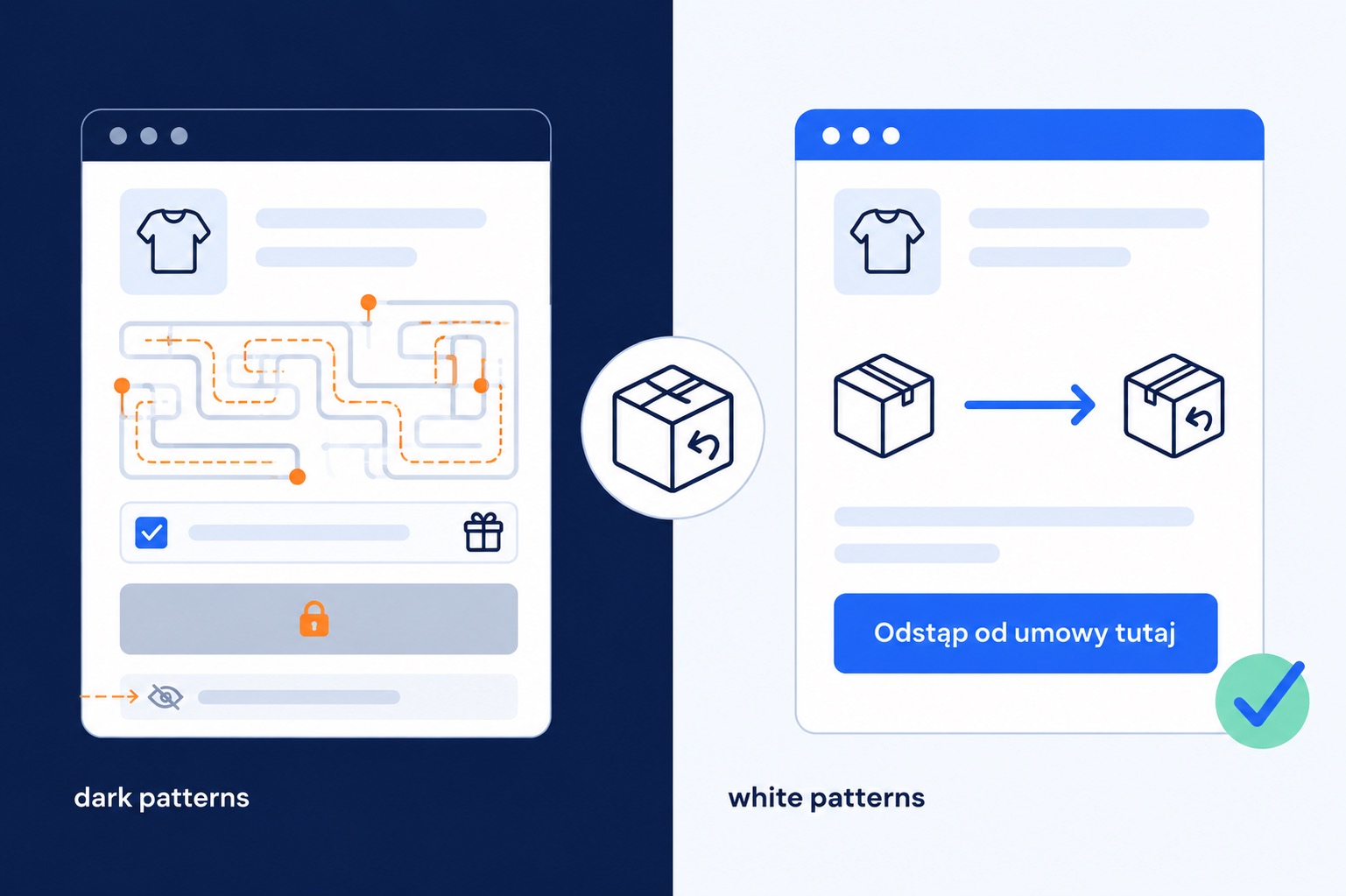
A customer wants to return a jacket. They find the returns link only in the terms and conditions, in paragraph seven. The form requires a login. At the end, a shop voucher is ticked by default, and the refund to the original payment method is a grey link underneath.
Some customers give up at this point. The rest send the jacket back anyway, just without a request, and a few days later email to ask about their money. An obstacle in the form rarely stops the parcel. It stops the information about it.
What dark patterns in returns are
Dark patterns are design choices that steer the customer’s decision against their own interest. They hide an option, lengthen the path or make the choice that favours the store the default. In a return process they have one goal: the customer gives up, or takes something other than their money back.
“White patterns” is an industry term, not a legal one. In this article it means a process where the customer sees at once how to return the goods, gets through without obstacles and receives a confirmation. The store may offer an exchange or a voucher, but it does not make the decision for the customer.
So the line does not run between a simple form and a complex one. It runs where the store stops asking and starts obstructing.
What the law says, and what it does not
This is easy to oversimplify. Directive (EU) 2023/2673 contains an explicit ban on deceptive interfaces (Art. 16e), but that provision applies to distance contracts for financial services. It does not cover a store selling clothes, electronics or cosmetics.
A store is covered by another part of the same directive: Art. 11a, the withdrawal function. If the customer bought through a website or an app, they must be able to withdraw from the contract in the same interface. The function must be labelled “withdraw from contract here” or an equally unambiguous wording, available throughout the withdrawal period, prominent and easy to find. Sending the statement takes a second step: a “confirm withdrawal” button. The store then sends, without undue delay, a confirmation on a durable medium with the content of the statement and the date and time it was submitted. In the countries that have transposed the directive, the rules apply from 19 June 2026.
Poland missed the transposition deadline. The draft amendment to the Consumer Rights Act (UC169) was published on 9 September 2026, and adoption by the Council of Ministers is planned for Q1 2027. The draft confirms that the withdrawal function will cover all distance contracts, not only financial ones. Like the directive, it does not extend the ban on deceptive interfaces beyond financial services.
That does not mean dark patterns in returns are allowed. Some of them break rules that have been in force for years:
- a consumer may withdraw from a distance contract within 14 days (Art. 27 of the Polish Consumer Rights Act);
- the store refunds the payment within 14 days using the same payment method the customer used, unless the customer expressly agreed to another method that costs them nothing (Art. 32);
- the President of UOKiK may treat a manipulative interface as a practice infringing collective consumer interests. Such practices can be fined up to 10% of turnover.
On the horizon there is also the Digital Fairness Act, an EU regulation meant to cover deceptive interfaces across all industries. The European Commission has announced a proposal for Q4 2026. That is only the start of the legislative work, so for now it does not bind stores, but it shows the direction.
Five patterns that make returns harder
A return buried in the terms
The only route to a return is a PDF of the terms or an email address in the footer. The customer writes “how can I return the goods”, someone from support replies by hand, and the parcel arrives anyway, sometimes with a note, sometimes without. Once the Polish act is in force, this setup will not meet the requirement of a permanently available, prominent withdrawal function.
The fair version: a “Returns” link in the footer, in the customer account and in the order confirmation email.
A path longer than the purchase
You can buy without an account, but a return requires logging in. Or the request is accepted only by a hotline, a chat or a separate app. This asymmetry is the simplest warning sign: if returning goods takes more steps than buying them, the process works against the customer. Art. 11a points the same way: withdrawal should be possible where the contract was concluded, and a logged-in customer should not have to enter their details again.
The fair version: an order number and an email address are enough to submit a request.
A voucher as the default
A shop voucher is ticked in advance, and the refund shows up only after expanding the options or contacting support. Art. 32 is clear: refund by the same payment method, another one only with the customer’s express consent. A box ticked by the store is hardly an express consent.
The fair version: two equal options. If the voucher has a real advantage for the customer, for example a higher value than the refunded amount, the customer will choose it knowingly on their own.
“Are you sure?” three times
A retention offer pops up at every step, and the decline button reads “No, I’d rather lose the discount”. This mechanism even has a name: confirmshaming. It should be told apart from the single confirmation step that Art. 11a requires. The “confirm withdrawal” button protects the customer from an accidental click. Repeatedly nudging them to change their mind serves only the store.
The fair version: at most one offer, a neutrally worded decline button, then the confirmation.
Silence after submitting
The customer submits a request and gets nothing: no email, no case number, no place to check the status. A week later they write, because they do not know whether the store received anything. The draft rules require a confirmation on a durable medium with date and time. An email alone is the minimum, though, not the goal.
The fair version: a confirmation immediately after submission and a status visible to the customer: parcel received, decision made, money sent.
Where obstruction breaks down in practice
Dark patterns are usually designed around a single metric: how many customers finished the form. The cost lands elsewhere.
Customer support gets more emails saying “how do I return the goods” and “what about my money”. The warehouse sees unannounced returns, that is, parcels that arrive without a request. Someone opens the box, finds no note and searches the mailbox for the order by surname. Finance faces a higher risk that a customer who did not get their money on time will go to the bank or to a consumer ombudsman.
So obstruction does not reduce the number of returns in any way you could plan for. It moves them to the channels where the store has the least control: the mailbox and the warehouse dock.
Go through your own return as a customer
Walk the return path the way a customer would: from a phone, without logging in, starting at the home page.
- You find the returns link without opening the terms and conditions.
- A return requires nothing that the purchase did not: an account, an app, a call to a hotline.
- A refund to the original payment method is as visible as a voucher or an exchange.
- You can decline a retention offer at most once, with a button that does not judge you.
- After submitting, you get an email with the content of the request, the date and the time.
- You know where to check what happens next.
Every “no” is a place where the customer will either give up or work around the form. In both cases the store learns about the return later than it could have.
If you are implementing the withdrawal button itself, our article on the mandatory return button walks through what the directive requires and how the flow should look.
FAQ
Does the ban on dark patterns in Directive 2023/2673 apply to my store?
Not directly. Art. 16e of the directive, which lists the prohibited deceptive interfaces, applies to distance contracts for financial services. An online store is subject to Art. 11a, the obligation to provide a withdrawal function, and manipulative practices in its interface can be pursued by UOKiK under consumer protection law.
Does a Polish store already have to have a “withdraw from contract” button?
As of October 2026: the directive has applied in the EU since 19 June 2026, but the Polish implementing act is at the draft stage (UC169), and its adoption by the government is planned for Q1 2027. The direction is settled, because the draft covers all distance contracts. Stores selling to customers in other EU countries should check whether the rules already apply there. We describe the consequences of not implementing it in the article on the mandatory return button.
Propose, don’t decide
A store has the right to fight for the customer: to propose an exchange, a voucher or another size. It has no right to make that decision for them by hiding the route it does not like. The simplest test: can a customer who just wants to return the goods and get their money back get through the path without reading the small print and without declining more than once?
In RetJet, the customer submits a request without logging in, using the order number and email address, and the withdrawal function supports the requirements of Art. 11a of the directive. See how the withdrawal function works in RetJet.