

Abandoned return
A customer fills out the return form, gets confirmation, maybe even a label… and silence. The package never makes it to the post office, the carrier tracking shows nothing, support has no updates. These situations are abandoned returns. They happen more often than you think.
Why track this at all? Because abandoned returns affect costs, cash flow, support ticket volume, and sales. Sometimes an abandoned return is good news – the customer changed their mind and kept the product. Sometimes it’s a disaster – the customer tried to return but the process was so painful they gave up and will never come back.
This article explains exactly what an abandoned return is, how to measure it, when to celebrate, and when to fix it. You’ll get a concrete 30-day action checklist.
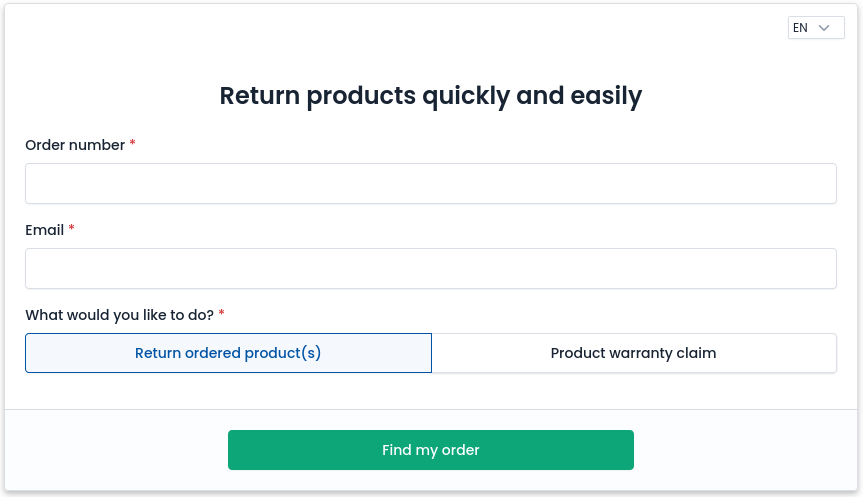
What Is an “Abandoned Return”
An abandoned return is a return that a customer initiated but never completed.
There are two types of abandonment:
- Abandoned mid-process – the customer entered the returns portal, started filling out the form, but never created an RMA (Return Merchandise Authorization). Maybe they clicked “return”, saw how many steps, how many questions… and closed the page.
- Abandoned post-label – the RMA exists, a label (PDF or QR code) was generated, but the package was never shipped. The customer had everything ready, yet the return never reached the warehouse.
This isn’t a legal term, just a returns process KPI. It tells you where you’re losing customers or money.
Is This Common or Rare?
In many stores, it’s normal for some returns to “die” along the way. There’s no magic number.
The scale depends on:
- industry (fashion vs. electronics – different behaviors)
- product price (the more expensive, the stronger the motivation to return)
- return convenience (QR code at a pickup point vs. printer and post office)
- season (after Christmas, returns rise, abandonments too)
- return policy (are you clear about who pays for shipping?)
If you have 15% abandonment in fashion and 3% in electronics – that might be OK. If you have 40% and support tickets about return issues are rising – customers are fighting the process instead of voluntarily giving up.
How to Measure It
Three metrics. You don’t need more to start.
1. Return Initiation Rate
Return initiation rate = initiated returns / delivered orders
This tells you how many customers even think about returning. If you initiate 30% returns but ultimately receive 18% – somewhere along the way 12 percentage points abandon.
2. Return Abandonment Rate (Post-Label)
Return abandonment rate = (RMAs with labels but no scan in X days) / (all RMAs with labels)
Usually calculated for X = 7 or 14 days. If a label sits for a week without a scan – that’s likely abandonment, not delay.
3. Time-to-First-Scan
Time-to-first-scan = average time from label generation to first carrier scan
If it’s 2 days – great. If it’s 9 days – customers are hesitating. Maybe they don’t know what to do next, maybe they’re waiting until they have money for shipping if the return isn’t free. There could be many reasons.
How to implement this?
Track three points: customer clicked “return”, generated label, carrier scanned package.
Best: integration with carrier API (InPost, DPD, Royal Mail, UPS) – first scan comes automatically.
Without API: add a “shipped” button in the returns portal – customer confirms themselves. Less accurate, but better than nothing.
Why Returns Are Abandoned
Two reasons. One can be good. The other always hurts.
A) Abandoned because the customer… changed their mind (this can be good)
- cooled down – the product isn’t as bad as they thought
- found a use for it – “actually, I’ll wear this to New Year’s”
- got help – instructions, live chat, a video showed them how it works
- chose an exchange or store credit instead of a return
In these cases, abandoned return = saved sale. You don’t lose the product, you don’t lose the customer.
B) Abandoned because the process… is too cumbersome (this is usually bad)
- need to print a label (who has a printer in 2026?)
- unclear instructions: “what do I do with this QR code?”
- unclear who pays for return shipping
- long refund times or unclear messages “when will I get my money back?”
- too many steps: login, form, photos, descriptions, uploads
In these cases, abandoned return = frustrated customer. They might not leave a negative review immediately, but next time they’ll buy elsewhere.
Key point: The same KPI can mean two opposite things. That’s why it matters where and why it was abandoned.
Is an Abandoned Return Good or Bad?
It depends.
When It Can Be Good (and for Which Stores)
Abandoned returns are OK if:
- High margin – you can offer a bonus for store credit or exchange without pain. Customer stays, you profit.
- Products where size/color is often the issue – exchange saves the sale. In fashion, an abandoned return often ends with an exchange for a different size.
- Stores with a smart save-flow – one-click exchange, credit + bonus, help with product selection. Customer doesn’t fight the system, they get help.
- Categories where “instructions/support” actually solves the problem – e.g., consumer electronics, fitness accessories, DIY. Often the customer returns because they don’t know how to use it, not because the product is bad.
How to ethically increase the abandoned return rate?
It’s not about hiding the return option. It’s about giving the customer a real alternative.
- In the returns portal: exchange/credit first (refund always available, but lower)
- Offer “credit + 10% bonus” as a faster option – not as hiding the return
- One-click decision change after generating label – “Changed your mind? Cancel return here”
- Reminders (SMS/email) with a button to “change to exchange” or “cancel return”
- Contextual help at the return reason: size chart, FAQ, chat with consultant
The principle is simple: “deepening” should mean more decision changes from “refund” to “keep product”, “take exchange” or “voucher”. It’s not about making returns harder, it’s about offering a better alternative.
When It’s Bad (and for Which Stores)
Abandoned returns are a problem if:
- Low margin / bulky items – an abandoned return locks the product in the system (you don’t know if it’s coming back), you lose the opportunity to sell it, and the customer leaves a bad review because “return was impossible”. In low margin, every bad review costs more than the profit.
- Stores where returns are a trust element – e.g., premium, beauty. If a customer wants to return a £50 cream and can’t because the process is difficult – you lose that customer forever and get a bad review that scares off others.
- Abandonment rate rises alongside: number of support queries about the returns process in general, negative reviews, chargebacks. This means customers aren’t giving up voluntarily – they’re fighting the process.
- Most abandonments happen after label generation and on mobile – customer doesn’t have a printer, doesn’t know what to do with the PDF. They abandon not by choice, but from frustration. Result: bad review “store makes returns impossible”. Very likely chargeback and a customer lost, possibly forever.
How to eliminate this?
- QR codes instead of PDFs, parcel lockers and pickup points instead of post offices
- Clear communication: how long the refund takes and when you start counting the deadline
- Simpler portal – fewer fields, no login required
- Automatic reminders + easy return cancellation
- Single return status page – track & trace in one place
Goal: customer should know what to do next and be able to do it in 30 seconds, even on their phone.
Warning Signs and “It’s Working” Signs
Warning signs (react quickly):
- Rising abandonment + rising support contacts about returns
- Many abandonments with one carrier or return method
- Complaints in reviews: “can’t return”, “don’t know what to do next”
- Abandonments mainly on mobile (sign that the process is too difficult on phone)
- Rising chargebacks – customer files complaint with bank instead of returning
Signs it’s healthy (don’t fix what works):
- Abandonment rises, but so do exchanges and voucher purchases (not just voucher redemptions) – this confirms the customer came back and didn’t lose trust in the store
- Declining number of tickets about return status
- Rising repeat purchases within 7-14 days of initiating return
- NPS and store ratings aren’t dropping
- Time-to-first-scan is short (2-3 days) – customers aren’t hesitating
If you see healthy signs – don’t touch the process. Maybe add an A/B test, but don’t change everything at once.
How to Organize This: Mini 30-Day Implementation Checklist
Week 1 – Measurement
- Add system events: return initiated, label generated, first scan, completed, cancelled
- Set up report: abandonment after 7 and 14 days
- Take first measurement – how many abandonments do you have today
Week 2 – Quick Improvements
- Shorten return form – remove questions that only you care about
- Add magic link instead of login (customer clicks in email and is immediately in the system)
- Add clear “what’s next” messages after summary display or label generation
Week 3 – Saving Sales
- Exchange and discount code or store credit as first options (refund lower, but visible)
- SMS/email reminders with one-click decision change
- Test credit bonus (e.g., +10% for exchange to voucher)
Week 4 – Customer Personalization
- Different paths for: high/low order value, new/returning customer, product categories
- E.g., new customer: more explanations. Regular customer: faster path without unnecessary steps.
- Analyze data from week 1 and adjust the process
You don’t have to do everything at once. First measure, then eliminate the biggest obstacles.
FAQ
After how many days should a return be considered abandoned?
It depends on shipping method. For QR code at parcel locker: 7 days. For printed label: 14 days. For high-value products: you can wait 21 days, as customers may delay out of caution.
Is an abandoned return a profit?
Not always. If the customer abandoned because they changed their mind – yes. If they abandoned because the process was difficult – you lose on reviews and future purchases. Check support tickets and reviews.
Won’t reminders annoy customers?
Not if they’re helpful. “Hey, you generated a label – need help?” is OK. “RETURN NOW OR LOSE YOUR RIGHTS!!!” is not OK. Tone matters.
Can you promote vouchers instead of cash refunds?
Yes, as long as refund is also available. Don’t hide cash refunds. Instead: offer a voucher bonus (+10%), faster refund time (“voucher immediately, cash in 7 days”). Customer has a choice.
What if a customer comes back after 3 weeks?
If the return is within the deadline – accept it. If after – that’s your business decision. But always: communicate this clearly in the return policy. “You have 30 days from delivery” is one thing. “You have 30 days, but generate the label within 14 days” is another.
Conclusion
An abandoned return is a signal, not a verdict. It can mean friction in the process or a saved sale. Measure where and why it was abandoned – only then change the process.
Bibliography
Narvar – State of Returns 2024
https://corp.narvar.com/resources/2024-state-of-returns-report
Optoro – Returns Unwrapped 2024
https://info.optoro.com/report-state-of-retail-returns-2024
Happy Returns & NRF – Consumer Returns Report 2025
https://happyreturns.com/2025-happy-returns-nrf-returns-report
NRF – Consumer Returns in Retail Industry 2024
https://nrf.com/research/2024-consumer-returns-retail-industry
InPost – Financial Results & Reports
https://inpost.eu/investors/financial-results